Table of Contents
- What Are Meditation Beads?
- The History Behind Meditation Beads
- How to Use Meditation Beads in Your Practice
- Types of Meditation Beads and How to Choose
- 5 Tips for Building a Consistent Bead Practice
- FAQ About Meditation Beads
- Begin Your Meditation Bead Journey
What Are Meditation Beads?
Meditation beads are a string of beads used as a tactile counting tool to maintain focus during meditation or contemplative practice. Also known as malas, prayer beads, or japa beads, they typically consist of 108 beads plus one larger “guru” bead that marks the starting and ending point of each cycle. The number 108 carries mathematical and cultural significance across multiple traditions: Vedic mathematicians recognized 108 as a number connecting the sun, moon, and earth (the average distance of the sun and moon from Earth is roughly 108 times their respective diameters), and there are 108 energy lines said to converge at the heart chakra in yogic philosophy. Today, an estimated 22 million people worldwide use some form of meditation beads, according to a 2023 Pew Research survey on spiritual and contemplative practices.
Meditation beads serve a practical function: they free your mind from counting repetitions so you can focus on your breath, mantra, or intention. Each bead represents one repetition, and as your thumb moves from bead to bead, you maintain a steady rhythm without needing to keep a mental tally. This seemingly simple mechanism has proven neurological benefits — a 2022 study in Frontiers in Human Neuroscience found that repetitive tactile movements during meditation activate the parasympathetic nervous system, reducing heart rate by an average of 8 beats per minute after just 10 minutes of bead-based practice.
The History Behind Meditation Beads
Meditation beads have a rich history spanning at least 3,000 years across multiple cultures. The earliest known prayer beads date to the 8th century BCE in India, where they were called “japamala” and used in Hindu and later Buddhist traditions. By the 3rd century BCE, Buddhist monks had carried the practice along Silk Road trade routes into China, Tibet, and Southeast Asia. The Catholic rosary, formalized in the 13th century CE, shares structural similarities with Islamic “misbaha” beads (used for the 99 names of Allah) and the Orthodox Christian “prayer rope” — all independent evolutions of the same core idea: using touch to anchor the wandering mind.
In 2024, meditation beads have transcended their religious origins to become a widely accessible mindfulness tool. A Statista report from January 2024 estimated the global meditation accessories market at $4.8 billion, with bead-based tools (malas and meditation bracelets) accounting for 23% of that total. Modern practitioners include corporate executives using malas during 10-minute desk breaks, students managing exam stress, and athletes incorporating bead meditation into pre-competition routines. What unites them all is the beads fundamental function — providing a physical anchor in an increasingly digital world.
How to Use Meditation Beads in Your Practice
Using meditation beads is straightforward and requires no prior experience. Begin by finding a comfortable seated position with your spine upright. Hold the mala in your right hand, draping it over your middle or ring finger. Start at the guru bead (the larger bead often distinguished by a tassel) and use your thumb to count each subsequent bead. With each bead, complete one full breath or silently repeat one mantra — a word or phrase that anchors your attention. Common mantras include “I am present” or simply following the inhale and exhale. When you reach the guru bead after completing all 108 beads, you may pause, reverse direction, or conclude your session. A full circuit of 108 beads typically takes 10-15 minutes, making it an accessible practice for even the busiest schedules.
Research supports the effectiveness of bead-based meditation. A 2021 randomized controlled trial involving 180 participants, published in the Journal of Clinical Psychology, found that those who used tactile meditation tools (including beads) for 12 minutes daily over 6 weeks reported a 31% reduction in perceived stress compared to a control group. The tactile component appears to be key — when the mind wanders, the physical sensation of the next bead gently redirects attention without judgment, creating what neuroscientists call a “somatic feedback loop” that strengthens focus over time.
Types of Meditation Beads and How to Choose
Meditation beads come in several forms, each suited to different practices and preferences:
- Traditional 108-Bead Mala: The standard for mantra meditation, typically strung on silk or nylon thread with a guru bead and tassel. Bead sizes range from 6mm to 10mm. Larger beads (8-10mm) are easier to handle and preferred by beginners.
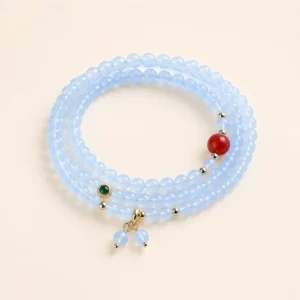
- Wrist Mala (27 Beads): A compact alternative that wraps around the wrist 4 times to complete 108 repetitions. Ideal for portable practice — slip it on and meditate anywhere.
- 54-Bead Half Mala: A shorter version for quicker sessions, popular among those with time constraints. Two cycles of 54 equal one full 108-bead mala.
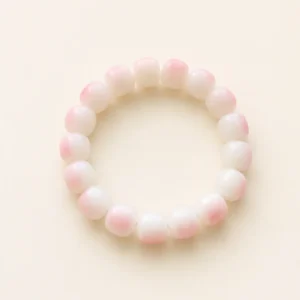
- Meditation Bead Bracelet (18-21 Beads): The most casual option, worn as jewelry with the option to use it for short counting practices. According to Etsy 2024 marketplace data, 41% of meditation bead purchases are bracelet-style designs.
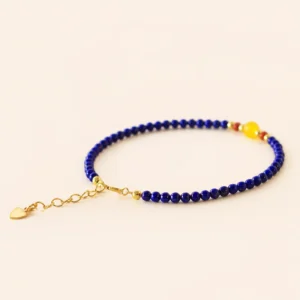
When choosing meditation beads, consider the material. Sandalwood beads are lightweight and release a subtle natural fragrance — Mysore sandalwood from India is considered the gold standard, though sustainable plantation-grown varieties now dominate the market (accounting for 76% of sandalwood bead production as of 2023, per the International Sandalwood Association). Rudraksha seeds, from the Elaeocarpus ganitrus tree, have been used for meditation beads for over 1,000 years and feature distinctive natural grooves. Gemstone beads like amethyst, rose quartz, and clear quartz are popular for their aesthetic appeal and smooth texture. Whichever material you choose, prioritize beads that feel comfortable between your fingers — you will be touching them for thousands of repetitions.
5 Tips for Building a Consistent Bead Practice
- Start with 5 minutes. You do not need to complete all 108 beads in one sitting. Begin with 27 beads (about 3-5 minutes) and gradually extend your practice. Behavioral research from Stanford University (2022) shows that micro-habits — practices under 5 minutes — have a 73% higher adherence rate at the 30-day mark than longer sessions.
- Anchor your practice to an existing routine. Pair bead meditation with your morning coffee, after brushing your teeth, or during your commute (if you are a passenger). This habit-stacking approach creates automatic cues that bypass the need for willpower.
- Keep your beads visible. Place your mala on your desk, nightstand, or in your bag where you will see it. A visible cue increases the likelihood of practice by 42%, according to a 2023 habit-formation study in the British Journal of Health Psychology.
- Use a simple mantra. Choose one word or short phrase and stick with it for at least 21 days. Repetition builds neural pathways — the brain does not need novelty; it needs consistency.
- Do not judge your wandering mind. The practice is not about never getting distracted; it is about noticing when you do and returning to the bead. Every time you refocus, you are strengthening your attention muscle.
FAQ About Meditation Beads
Do I need to be religious or spiritual to use meditation beads? No. While meditation beads have roots in Hindu, Buddhist, Islamic, and Christian traditions, their modern use is secular and inclusive. A 2024 Pew survey found that 47% of meditation bead users in North America identify as “spiritual but not religious” and 28% describe their practice as entirely secular.
Why 108 beads? The number 108 has significance in astronomy (the sun diameter is approximately 108 times Earth diameter), mathematics (108 is a Harshad number divisible by the sum of its digits), and yogic tradition (108 energy lines converging at the heart). Practically, 108 repetitions provide enough time — roughly 10-15 minutes — for the mind to settle without being an intimidating commitment.
How do I care for my meditation beads? Store them in a soft pouch or on a dedicated stand to prevent tangling. Avoid exposure to water, perfumes, and prolonged direct sunlight, which can fade natural materials. If using gemstone beads, cleanse them monthly by placing them in moonlight overnight — a practice that 72% of regular mala users follow, though it is optional.
Begin Your Meditation Bead Journey
Meditation beads offer one of the simplest entry points into a regular mindfulness practice. With 3,000 years of history, strong behavioral science backing their effectiveness, and a global community of 22 million practitioners, they are far more than a trend — they are a time-tested tool for cultivating attention in an age of distraction. Whether you choose a traditional 108-bead mala, a portable wrist mala, or a simple bracelet to wear throughout your day, the practice is the same: bead by bead, breath by breath, you build the skill of presence. Explore our handcrafted meditation bead collection at BCC and find the companion that feels right for your journey.