Pick up almost any traditional mala and you will find 108 beads. The number appears so consistently across meditation traditions that it has become a quiet signature of the practice. But what does 108 mala beads meaning actually point to? The answer is part history, part symbolism, and part practicality.
If you are new to beads, you may want to start with our mala for beginners guide first, then come back here to explore why the count matters.
A number with deep roots
The number 108 has been considered significant for thousands of years in Hindu, Buddhist, and yogic traditions. It shows up in sacred texts, temple architecture, and contemplative practice. A full mala holds 108 counting beads, which lets a practitioner complete one round of a mantra, breath, or prayer per bead and arrive back at the start having repeated it 108 times.
There is rarely a single official explanation. Instead, many overlapping interpretations have accumulated over the centuries, which is part of what makes the number feel rich rather than arbitrary.
Some of the traditional interpretations
- Astronomy and rhythm: Some traditions connect 108 to the relationship between the sun, moon, and earth, noting that the distances and diameters involved approximate the number. It became a way of linking personal practice to larger natural cycles.
- The body and breath: Yogic texts describe a network of subtle channels said to meet at the heart, with 108 often cited among them. In this view the number reflects a sense of wholeness.
- Mathematics and harmony: 108 divides cleanly in many ways and has long been treated as a complete, balanced number in Vedic thought.
You do not have to subscribe to any one of these to appreciate the practice. Many people simply find that a fixed, generous count gives their meditation a clear shape with a beginning and an end.
The guru bead and what it marks
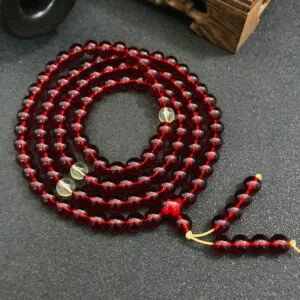
Beyond the 108 counting beads, a traditional mala usually has one larger bead, often called the guru bead or summit bead. It is not counted during recitation. Instead it marks the completion of a round. When your fingers reach it, you pause. Rather than crossing over the guru bead, practitioners traditionally turn the mala around and continue in the other direction. This small gesture builds in a natural moment of reflection.
Why the count helps your practice
The genius of 108 is practical. Counting breaths or repetitions in your head is easy to lose track of. The beads do the counting for you, which frees your attention to rest on the breath or mantra itself. If you want to learn the mechanics, our walkthrough on how to meditate with mala beads shows exactly how to move through a strand.
A full 108-bead strand also creates a meaningful commitment. One complete round usually takes several minutes, long enough to actually settle but short enough to fit into a daily routine. A traditional strand such as The Handheld 8 — for Your Practice is sized for exactly this kind of seated counting.
Smaller counts and their logic
You will also see malas with 54, 27, or 21 beads. These are simply fractions of 108, designed for shorter sessions or smaller wrist wear. A 54-bead strand completes 108 repetitions in two rounds, while a 27-bead wrist mala does it in four. The underlying logic always traces back to that original number.
Holding the meaning lightly
The meaning of 108 is best held lightly. You can honor the tradition, draw on whichever interpretation resonates, or simply enjoy the steady rhythm the beads provide. What matters most is that the strand becomes something to hold onto, a small structure that helps your attention come home.